Why Your HVAC Energy Bill Is High in Burbank
Straight answer: A high Burbank cooling bill almost always means the Mitsubishi system works harder for the same comfort: leaky ducts, a dirty or oversized unit, or low refrigerant, magnified by 40-plus days above 90 F; Burbank Mitsubishi HVAC tests each for about $79 to $200, so call (213) 513-5256 or book a 91504 check online.
Key facts
- Top causes: duct leakage (often 20-30 percent), dirty filter/coil, low refrigerant, oversized or aging equipment.
- Burbank runs roughly 40-55 days a year at or above 90 F, so small inefficiencies cost real money.
- Free homeowner checks: filter, outdoor-unit clearance, all registers open.
- Refrigerant and duct-leakage testing pinpoints the actual loss; we measure before and after.
- A modulating Mitsubishi inverter uses less than an old single-stage unit cycling full-blast.
- Service area: Burbank and the 91501-91523 ZIPs.
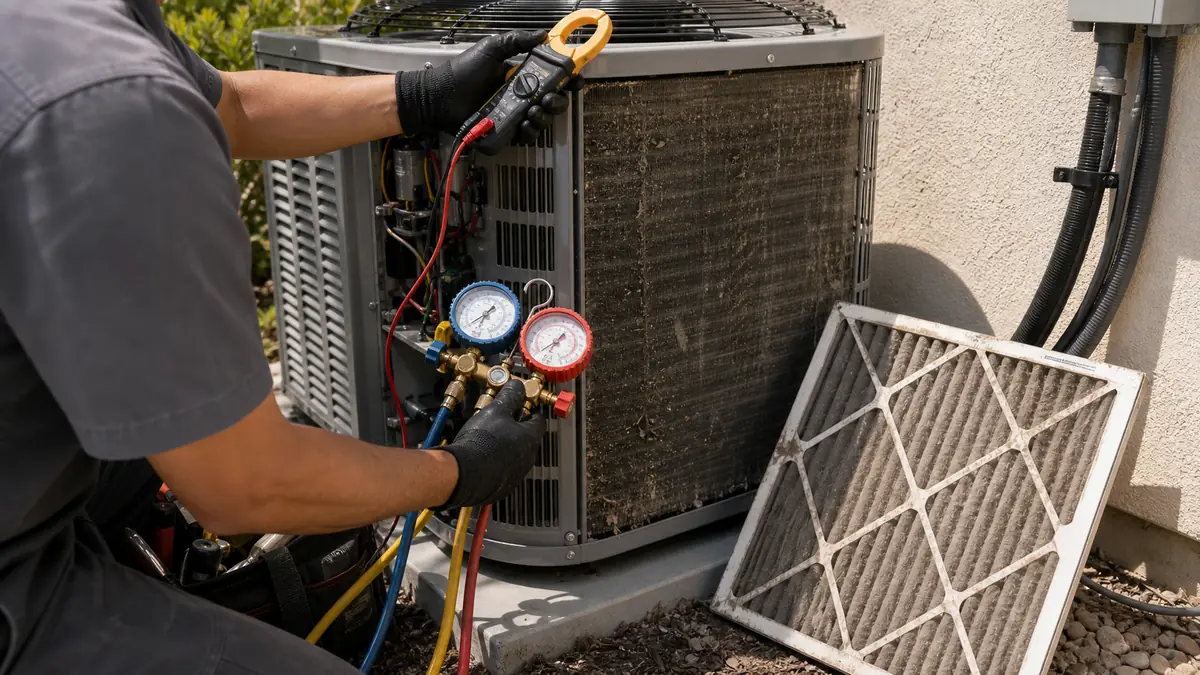
Where does the money actually go?
A high bill is rarely one villain. It is usually a stack of small losses that each force the system to run longer. The most common on the Burbank valley floor are duct leakage dumping cool air into a 130 F attic, a dirty filter or coil choking airflow, a slow refrigerant leak at a ductless flare joint, and equipment that is oversized or simply old. Because the cooling season here is long and hot, each loss is multiplied across hundreds of run-hours, so a 15 percent efficiency hit turns into a noticeably bigger bill.
How do I tell which cause is mine?
| Symptom | Likely cause / first check | Cost lane |
|---|---|---|
| Bill up, one room never cools | Duct leakage or a disconnected branch; leakage test | $300 - $2,000 |
| Runs constantly, weak cool air | Dirty filter/coil or low refrigerant (U7 / P8) | $120 - $1,500 |
| Short cycles, clammy air | Oversized system; sizing review | Replace decision |
| Old unit, steadily rising cost | Aging single-stage condenser; repair-or-replace math | $5,000 - $14,000 (replace) |
What can I do today, for free?
Start with the filter, because a clogged one starves the coil and is the cheapest fix in HVAC. Then walk to the outdoor unit and clear leaves, trash and the cottonwood fluff that drifts across valley yards in early summer, so the condenser can shed heat. Finally, make sure no one closed a register to save energy in an unused room, which usually backfires by raising static pressure. If the bill stays high after all three, the loss is inside the refrigerant circuit or the ducts.
How do you actually diagnose a high bill, in order?
A high-bill call is detective work, and we run it in a set order so we are not guessing. First we read the equipment: model, age, and on a Mitsubishi system the kumo log or controller for any stored P, U or E code that points at a fault running quietly in the background. Second we check airflow, the filter and the indoor coil, because a starved coil makes the system run long for weak output. Third we measure the refrigerant circuit by superheat and subcooling, not just a gauge glance, since a slow flare-joint leak (U7, P8) can knock real capacity off without ever fully failing. Fourth, on a ducted home, we test for duct leakage, which on Burbank's older stock commonly runs 20 to 30 percent and dumps cooled air into a 130 F attic. Fifth we sanity-check sizing and the thermostat schedule. Only after those readings do we say where the money is going, because "your bill is high" has at least five common causes and they do not cost the same to fix.
What does each fix cost to put right?
Once we know the cause, the cost-to-fix splits cleanly, and most of the cheap wins are the common ones. A dirty filter or coil is the cheapest, often just the price of the visit plus a cleaning. A refrigerant leak repair and recharge runs about $225 to $1,500 depending on where the flare leak is and how much R-410A the system lost. Duct sealing on a leaky older system lands around $800 to $3,100, and it is one of the highest-return fixes here because it stops the attic from eating your cooling. A genuinely oversized or aged single-stage condenser is the expensive answer, $5,000 to $14,000 to replace, but it is also the one with the biggest annual saving over a long valley cooling season.
| Cause | Fix | Cost lane |
|---|---|---|
| Dirty filter / coil | Clean, restore airflow | Visit + cleaning |
| Low refrigerant (U7 / P8) | Find leak, repair flare, recharge | $225 - $1,500 |
| Duct leakage 20-30% | Seal ducts, HERS verify | $800 - $3,100 |
| Oversized / aged condenser | Right-sized inverter replacement | $5,000 - $14,000 |
When is replacement the real answer?
When the system is old, oversized and leaking efficiency every hour it runs. A modulating Mitsubishi inverter that ramps to match the load uses far less than a 14-year-old single-stage condenser slamming on and off all afternoon. We will not push a replacement you do not need, but we will show you the cooling-season cost difference. The numbers are on the repair-or-replace guide, and duct losses are covered on the duct sealing page.
Common questions about high Burbank energy bills
Why did my Burbank summer bill jump even though nothing changed?
Usually the system is working harder for the same comfort: a clogged filter or dirty coil, low refrigerant from a slow flare-joint leak, or duct leakage that got worse. On the valley floor a system already runs long through 40-plus days above 90 F, so a small efficiency loss shows up as a big dollar jump.
Is an old AC really costing me that much more?
It can. A 12-to-15-year-old single-stage condenser at its original rating can use far more power than a modern Mitsubishi inverter that modulates instead of cycling full-blast. Over a long Burbank cooling season the difference compounds, which is part of the repair-or-replace math.
Will a high-SEER2 Mitsubishi system pay for itself?
Partly, and faster the more you cool. The savings are real but should not be oversold; sizing, sealed ducts and a clean coil matter as much as the SEER2 number. We model your actual usage rather than promising a payback period we cannot guarantee.
What can I check before calling?
Three things: replace a dirty filter, clear leaves and cottonwood fluff from around the outdoor unit so it can breathe, and confirm no register is closed off. If the bill stays high after that, it is time for a refrigerant and duct-leakage check.
Related: duct sealing, maintenance calendar, and high-SEER2 Hyper-Heat systems.