A Burbank HVAC Maintenance Calendar for Mitsubishi Systems
Straight answer: Maintain a Burbank Mitsubishi system on a heat-pocket rhythm: rinse the washable filters every 4 to 6 weeks all summer, book the professional tune in spring (February to April) before the heat, and clear the condensate drain pre-season; Burbank Mitsubishi HVAC tunes systems for the 91505 valley floor, so call (213) 513-5256 or book online.
Key facts
- Rinse washable mini-split filters every 4-6 weeks in summer; quarterly off-season.
- Book the annual professional tune in spring (Feb-Apr), before peak cooling demand.
- Pre-season condensate service prevents most P4/P5 drain leaks during heat waves.
- Burbank's 40-55 days/yr above 90 F mean a long, hard runtime; neglect shows up fast.
- Clear cottonwood fluff and debris from the outdoor unit so it can shed heat.
- Annual visit tightens S1/S2/S3 connections that drift loose and cause E6 comm faults.
Why does Burbank need its own maintenance rhythm?
Generic maintenance advice assumes a four-season climate where the air conditioner rests half the year. Burbank does not work that way. The southeastern San Fernando Valley floor sits in Title-24 Climate Zone 9, a cooling-dominant heat pocket where Hollywood Burbank Airport keeps logging valley-record highs and the system runs through roughly 40 to 55 days a year at or above 90 F. That long, hard duty cycle means filters load faster, condensate runs for weeks at a stretch, and the outdoor unit bakes in a side yard all summer. So the maintenance calendar here is front-loaded toward spring prep and frequent summer filter care, not the once-a-year-and-forget-it routine that suits a milder place.
There is a housing-stock wrinkle too. Many Burbank homes are 1920s to 1940s cottages retrofitted with ductless heads or squeezed-in ducts, and a lot of those mini-splits are mounted in dusty, plaster-walled rooms. The washable filters catch a steady stream of valley dust and, in early summer, the cottonwood fluff that drifts across the neighborhoods. That is why a Mitsubishi filter in Burbank needs rinsing more often than the manual's default suggests.
What is the month-by-month plan?
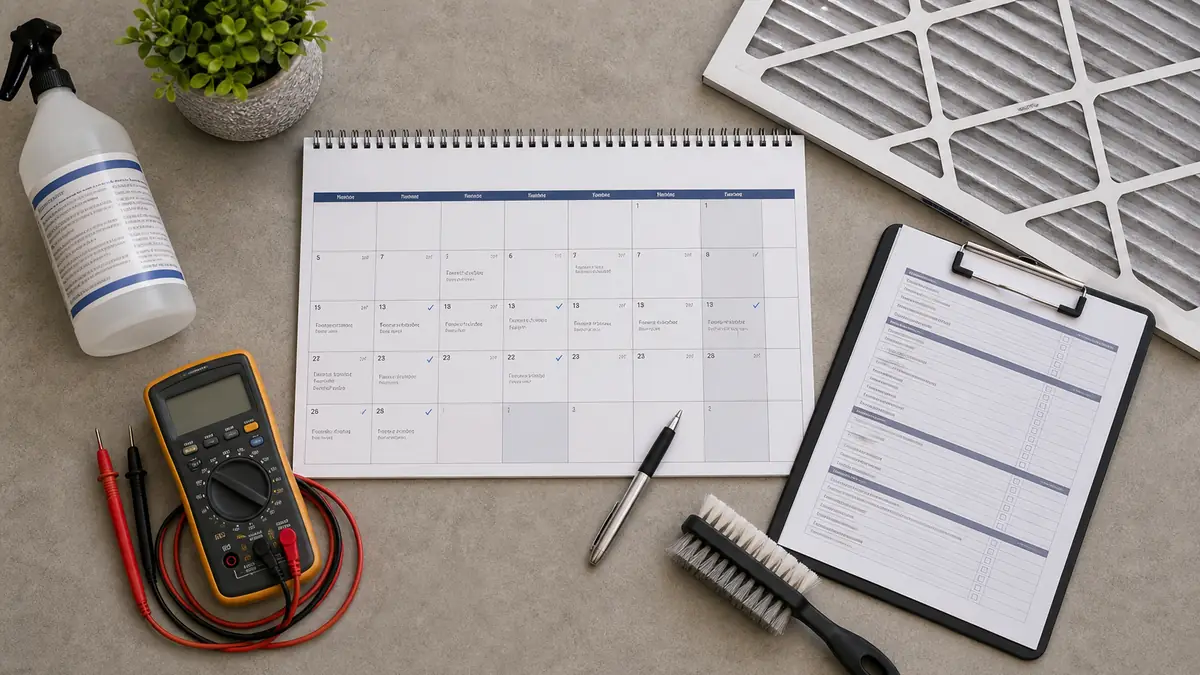
Here is the calendar we actually run for Burbank Mitsubishi systems, walked month by month against the Climate Zone 9 cooling curve. The headline items are spring prep and summer filter care; everything else is lighter, but each month earns one or two specific tasks.
| Month | Do this | Why it matters on the valley floor |
|---|---|---|
| January | Rinse filters once; run a short heat-mode cycle and listen for odd sounds | Low load, but a quiet month to catch a problem before spring booking fills up |
| February | Book the annual professional tune now; check the outdoor pad for winter settling | Beats the late-spring rush; a pad that heaved can stress the line set |
| March | Have the tech deep-clean the indoor coil and blower wheel; rinse filters | Coil grime built up over a year of cooling caps efficiency for the season ahead |
| April | Clear and treat the condensate drain; verify refrigerant charge and subcooling | A clean, treated drain in April prevents the August P4/P5 overflow |
| May | Clear winter debris from the outdoor unit; confirm 18-24 in of clearance | The condenser is about to run daily; it has to shed heat freely |
| June | Pick out cottonwood fluff from the coil fins; rinse filters as load ramps | Early-summer fluff mats the outdoor coil and triggers high-pressure U1 trips |
| July | Rinse filters every 4-6 weeks; watch for weak cooling or a creeping bill | Peak 90-95 F runtime loads filters fast and exposes any weak charge |
| August | Rinse filters; check the drip from the outdoor drain to confirm condensate flows | The hottest, longest-runtime stretch; drain and capacitor failures cluster here |
| September | Rinse filters; note any short-cycling or rising noise from the condenser | Heat lingers into September on the valley floor; the system is still working hard |
| October | Rinse filters; run a full heat-mode test before the cooler nights | Confirms the reversing valve and defrost work before you rely on heat |
| November | Wipe down indoor heads; check that the kumo app or controller logs are clean | A stored fault code surfaces now, with time to fix it off-season |
| December | Rinse filters quarterly; keep the outdoor unit clear of leaf fall | Light load, mild Burbank winters; minimal work but do not skip the filter |
If you only ever do three things, make them these: rinse the filters on schedule, book the spring drain-and-charge service, and keep the outdoor coil clear. Those three head off the large majority of the no-cool and leak calls we run between July and September.
What does the spring professional visit actually include?
The once-a-year visit is where the deeper work happens, the parts a homeowner cannot reach safely. On a Mitsubishi ductless system we pull and deep-clean the indoor coil and the squirrel-cage blower wheel, because a film of dust on the blower quietly drops airflow and pushes the coil toward a P6 freeze trip. We flush and treat the condensate drain line, confirm the gravity slope or test the drain pump cycle, and check the float or drain sensor that throws P4. We read refrigerant performance through superheat and subcooling rather than just gauge pressure, since a Mitsubishi inverter's charge has to be precise. We re-torque the S1/S2/S3 inter-unit terminals that vibrate loose over a hot season and throw E6-class comm faults, inspect the contactor and the run capacitor on the outdoor unit for the pitting and bulging that precede a summer failure, and clear the outdoor coil. The whole point is to find the August breakdown in April, when it is a cheap fix instead of an emergency.
| Task | Component | Fault it heads off |
|---|---|---|
| Deep-clean coil and blower wheel | Indoor coil, ECM blower | P6 freeze, weak airflow, high bill |
| Flush and treat drain, test pump | Drain pan, pump, float/drain sensor | P4 / P5 overflow onto the wall |
| Verify charge by superheat/subcooling | Refrigerant circuit, flare joints | U7 low charge, short-cycling, frost |
| Re-torque S1/S2/S3 terminals | Inter-unit wiring | E6-E9 communication dropouts |
| Inspect capacitor and contactor | Outdoor electrical | No-start hum on a hot afternoon |
What can I do myself, and what needs a tech?
Plenty is homeowner work. Rinsing the washable filters on a Mitsubishi wall head takes minutes and is the highest-value thing you can do, because a clogged filter starves the coil and causes most freeze and weak-cooling complaints. Keeping the outdoor unit clear of leaves, trash and cottonwood fluff is just as easy and just as important on the valley floor. What needs a tech is the deeper work: a proper coil and blower-wheel cleaning, flushing and treating the condensate drain, verifying refrigerant performance, and re-torquing the S1/S2/S3 inter-unit connections that vibrate loose over a season and trigger E6-class comm faults.
| Task | Who | Frequency |
|---|---|---|
| Rinse washable filters | Homeowner | 4-6 weeks in summer |
| Clear debris around outdoor unit | Homeowner | Monthly in summer |
| Coil and blower deep-clean | Professional | Annually, spring |
| Condensate drain clear and treat | Professional | Annually, pre-season |
| Refrigerant performance check | Professional | Annually |
| Tighten S1/S2/S3 connections | Professional | Annually |
How does maintenance tie into bills and breakdowns?
The two problems homeowners call us about most, a high summer bill and an August breakdown, are both largely preventable on this calendar. A clean coil and a correct charge keep a Mitsubishi inverter near its rated efficiency, which is the difference the high energy bill page walks through. A cleared, treated condensate drain prevents the P4/P5 leaking-water call that always seems to land during the worst heat. And re-seated wiring heads off the E6 comm faults common on longer line-set runs. Maintenance is not glamorous, but on the Burbank valley floor it is the cheapest insurance you can buy.
How do I rinse a Mitsubishi filter the right way?
It takes about five minutes per head and is the single highest-value thing a Burbank homeowner can do. Switch the unit off at the remote, then lift the front panel of the wall head, it hinges up and holds open. The two washable filters slide out from the top; on a deluxe MSZ-FS you may also see the small electrostatic or deodorizing filters clipped to them. Rinse the main mesh filters under lukewarm tap water from the back side to push the dust out the way it came in, never with a brush that tears the mesh. If they are greasy from a kitchen-adjacent head, a drop of dish soap helps. Let them air-dry fully in the shade, drying them in direct valley sun can warp the frame, then reseat them and close the panel. Do not run the head with the filters out, even briefly, because unfiltered air loads the coil directly and is far harder to clean off. On a multi-head MXZ-SM system, every indoor head has its own filters, so do them all on the same day.
What does skipping maintenance actually cost on the valley floor?
The failures we get called for in July and August are mostly the predictable end of a maintenance task someone skipped in spring. A clogged filter starves the coil, the coil ices, and the unit either short-cycles or throws a P6, on the hottest week of the year. A drain line that grew biofilm through June overflows in August as a P4 or P5 and stains a plaster wall in a day. A run capacitor that was already bulging in April finally fails on a 95 F afternoon, and now it is an emergency call with a queue ahead of it. None of those are exotic; they are the ordinary cost of a system running 40 to 55 days a year above 90 F with no spring prep. Set against that, a filter rinse and one annual visit is genuinely the cheapest insurance in the house. The high-bill side of the same story is on the high energy bill page, and the leak side on the water-leaking page.
Bottom line for Burbank: rinse filters every 4-6 weeks June through September, book the spring drain-and-charge tune in February through April, keep 18-24 inches of clearance around the outdoor coil, and run a heat-mode test each October. Do those four and you avoid most of what breaks here.
What about the equipment's own warranty?
If your Mitsubishi system is still under its parts-and-labor warranty, keeping up documented maintenance matters, because manufacturers can deny claims on neglected equipment. While in that window, warranty repairs on the sealed system should go to manufacturer-authorized service first. The upkeep, anything past the coverage window, and a no-spin second opinion are ours to handle; that split is how an honest Burbank independent stays on the right side of your warranty. When you are ready to plan replacements, the buying guide and repair-or-replace guide pick up from here.
Common questions about Burbank HVAC maintenance
How often should I change a Mitsubishi mini-split filter in Burbank?
The washable filters in a Mitsubishi wall head should be rinsed about every four to six weeks during heavy summer use, and at least quarterly the rest of the year. Burbank's valley dust and the cottonwood fluff that drifts through in early summer load filters faster than a milder coastal climate would, and a clogged filter is the single most common cause of P6 freeze trips and weak cooling.
Do ductless systems need professional maintenance at all?
Yes, beyond the filter rinse you can do yourself. A yearly professional visit deep-cleans the indoor coil and blower wheel, clears and treats the condensate drain, checks refrigerant performance, and tightens the S1/S2/S3 connections that drift loose and throw comm faults. That visit is what prevents the August breakdown.
When is the best time to service before summer?
Late winter through spring, roughly February to April, before the first real heat. Burbank's cooling season is long and brutal, so you want the drain cleared and the charge verified before the system is running every day. Booking in spring also beats the summer rush when every shop in the valley is slammed with no-cool calls.
Does maintenance actually lower my bill?
A clean coil, a clear filter and a correct refrigerant charge let the system hit its rated efficiency instead of running long and hard. It will not transform an old, oversized unit, but on a healthy Mitsubishi inverter, neglected maintenance can quietly add a meaningful chunk to a long Burbank cooling bill.
Related: repair or replace, buying guide, and the service menu.