Mitsubishi P, E and U Fault Codes in Burbank, Explained
Straight answer: On a Mitsubishi system in Burbank, P-codes flag indoor sensors, drain and freeze protection, E-codes flag communication, and U-codes flag outdoor compressor and inverter faults that can run $400 to $3,500; Burbank Mitsubishi HVAC reads them on the kumo app, then fixes the cause near 91505, so call (213) 513-5256 or book online.
Key facts
- P-codes: indoor sensors / protection (P4 drain float, P5 drain pump, P6 freeze/overheat, P1/P2/P9 thermistors).
- E-codes: communication and remote (E6-E9 indoor-outdoor, EA/EB wiring, E0-E5 wired controller).
- U-codes: outdoor / compressor / inverter (U1 high pressure, U2 high discharge, U6 overcurrent, U7 low charge, U8 fan, U9 voltage).
- F-codes: power-supply / phase, mostly 3-phase P-Series (F1/F2 phase, F3 low-pressure switch).
- Slow steady green blink is normal (standby/defrost); rapid patterned blink is a fault.
- Drain/thermistor codes are cheap; outdoor U-codes can run $400 - $3,500.
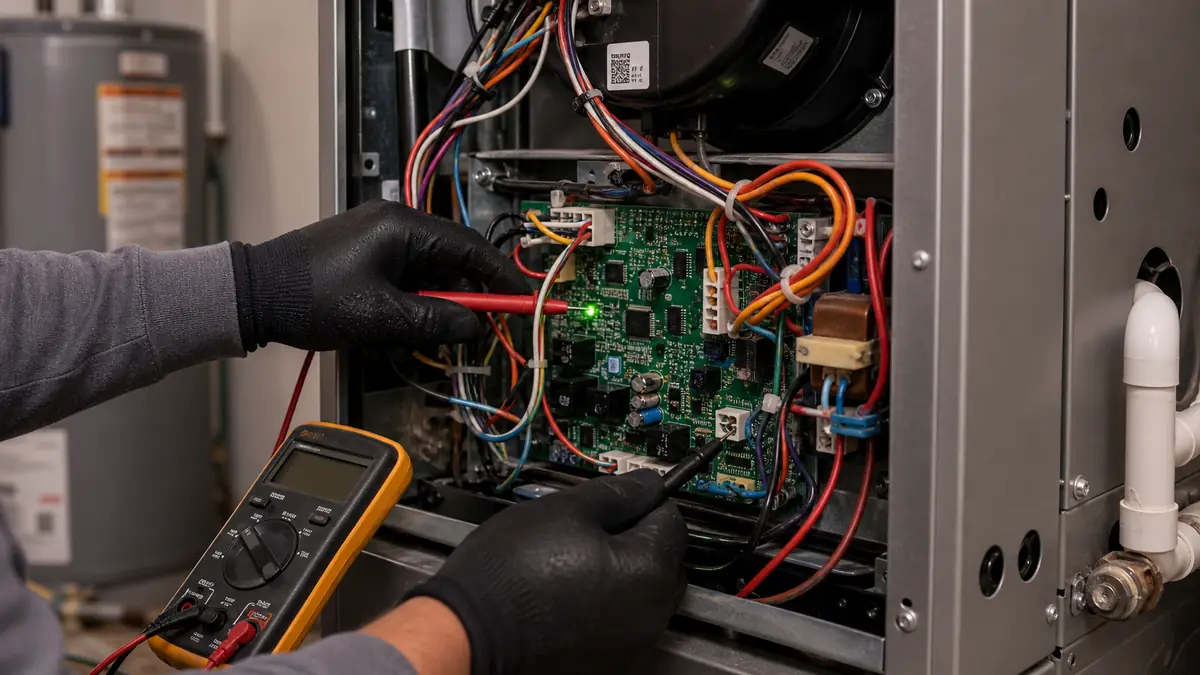
How do I read a Mitsubishi fault code?
Mitsubishi reports faults two ways: the green operation LED on the indoor head blinks a pattern, and the exact alphanumeric code shows on the wired controller or the kumo cloud app. A slow, steady green blink is usually normal, the unit is in standby, defrost or heat preparation. A rapid or patterned blink, often paired with the red timer light, means it is flashing an error. We count the flashes or pull the code from the app, because guessing from the symptom alone wastes a trip on the wrong part.
What do the most common Burbank codes mean?
These are the codes we actually see on valley-floor calls, with the first thing we check and a dated 2026 cost lane. Treat the lane as a range, not a quote.
| Code | Meaning / first check | Cost lane |
|---|---|---|
| P4 / P5 | Drain float or drain pump; clear the condensate path, test the pump | $120 - $450 |
| P6 | Freeze or overheat protection; dirty filter or coil, low airflow | $120 - $350 |
| P1 / P2 / P9 | Indoor thermistor (intake, liquid pipe, coil) open or short | $150 - $450 |
| E6-E9 / EA / EB | Indoor-outdoor comm or S1/S2/S3 wiring fault; reseat, test board | $200 - $2,000 |
| U7 / P8 | Low refrigerant / abnormal pipe temp; flare-joint leak search | $225 - $1,500 |
| U6 / UF / UP | Compressor overcurrent / inverter fault; test inverter PCB and compressor | $400 - $3,500 |
| U8 / U9 | Outdoor DC fan motor / over- or undervoltage | $300 - $1,500 |
Why does Burbank heat trigger certain codes?
A long Climate Zone 9 heat stretch loads the outdoor unit hard, which is when overcurrent and high-pressure protection (U6, U1) and over-temperature codes show up, especially on a condenser packed with cottonwood fluff or pressed against a fence in a tight Magnolia Park side yard. Indoor freeze protection (P6) climbs in summer too, because a clogged filter starves airflow exactly when the system runs all day. Clearance and a clean filter prevent a surprising number of these calls; the maintenance calendar has the timing.
Which codes can I clear myself, and which mean stop?
A few codes are soft and may not return after a power-cycle: a one-time P4 drain trip after a brief overflow, or a P6 freeze that clears once you swap a clogged filter and let the coil thaw. Those are worth a single reset attempt. But a code that comes straight back is the system protecting itself from a real fault, and clearing it without fixing the cause just invites damage. The hard-stop codes are the outdoor U-family: U6 (compressor overcurrent or inverter), U1 (high pressure), U2 (high discharge temp), and a U7 that signals low charge. Repeatedly resetting through one of those can cook a compressor or an inverter board, turning a $400 repair into a $3,500 one. The same goes for an E6-E9 comm fault that returns after a reset, which means a wiring or board problem that a reset cannot fix. When a code repeats, leave it flagged and call rather than clearing it on loop.
What about the in-warranty question?
If your Mitsubishi system is still inside its parts-and-labor warranty, a U-code involving the compressor or inverter board should go to manufacturer-authorized service first, because warranty work on the sealed system has to be done by an authorized dealer to stay covered. We will tell you honestly when you are in that window, then handle the out-of-warranty repairs, second opinions and everything else. For a neighborhood-specific walk-through, see the Chandler Park fault-code page.
Deep dives on the two codes we see most
Two P-codes drive most of our Burbank no-cool calls, and each has its own walk-through. A P5 drain-pump code means the indoor float sensed high condensate and shut cooling off, almost always a clogged line, a dead pump, or a stuck float. A P6 freeze and overheat code means the coil tripped its protection limit, usually low airflow from a dirty filter or low refrigerant from a flare-joint leak. Each page covers the cause in this city's homes, the step-by-step diagnosis, what you can safely check, and the 2026 cost lane.
Common questions about Mitsubishi fault codes
My Mitsubishi head is blinking the green light. Is that a fault?
Not always. A slow, steady green blink usually means standby, defrost or heat preparation, which is normal. A rapid or patterned blink, often with the red timer light, is the unit flashing an error. Count the flashes or read the kumo app or wired controller for the exact P, E or U code before assuming the worst.
What is the difference between P, E, U and F codes?
Roughly: P-codes point to indoor sensors and protection (drain, thermistors, freeze), E-codes to communication and the remote controller, U-codes to outdoor unit, compressor and inverter protection, and F-codes to power-supply or phase issues that mostly appear on 3-phase P-Series. Knowing the family tells us whether to start indoors or at the condenser.
Can I clear a Mitsubishi fault code myself?
You can power-cycle the unit, and a soft fault like a one-time drain trip may not return. But a code that comes right back is the system protecting itself from a real problem, low refrigerant, a comm fault, an overcurrent, and clearing it without fixing the cause just risks damage. We diagnose the underlying fault, then clear it.
Which fault codes are the expensive ones?
The outdoor U-codes tend to be. U6 (compressor overcurrent / inverter) and a failed inverter PCB can run 400 to 3,500 dollars depending on whether the compressor itself is involved and whether the part is in warranty. Drain and thermistor codes (P4, P5, P1, P2) are usually far cheaper to resolve.
Related: water leaking (P4/P5), reading codes via kumo cloud, and the full service menu.