Furnace Repair in Burbank, CA
Straight answer: Burbank Mitsubishi HVAC repairs gas furnaces across Burbank and the 91504 north end, fixing ignition, flame-sensor, inducer, pressure-switch and limit faults, with most repairs landing between $120 and $700. We are independent, we red-tag a cracked heat exchanger rather than patch it, and we will show you when a Mitsubishi Hyper-Heat heat pump beats the repair; call (213) 513-5256 or book online.
Key facts
- Common fixes: flame sensor, hot-surface igniter, inducer motor, pressure switch, high-limit, gas valve, control board.
- Diagnostic about $79 - $200; furnace replacement roughly $3,000 - $7,500 (CA Ultra-Low-NOx common).
- Mild Burbank winters mean a Hyper-Heat heat pump often replaces both furnace and AC; we quote both paths.
- Safety first: rollout / cracked heat-exchanger findings are red-tagged, not patched.
- Service area: Burbank, Magnolia Park, Burbank Hills, Media District and the 91501-91523 ZIPs.
- Independent, all-brand.
Why won't my Burbank furnace stay lit?
The single most common no-heat cause we see is a dirty flame sensor. The burner ignites, but the thin sensor rod is coated and cannot prove the flame to the control board, so the board closes the gas valve within a few seconds as a safety. Cleaning or replacing it solves most of these. The next tier is the hot-surface igniter, the inducer motor and pressure switch (which prove the flue is clear), and the high-limit switch that trips when airflow is too low, usually a dirty filter or coil. Each leaves a control-board flash code that tells us where to look.
How does a furnace repair visit actually go?
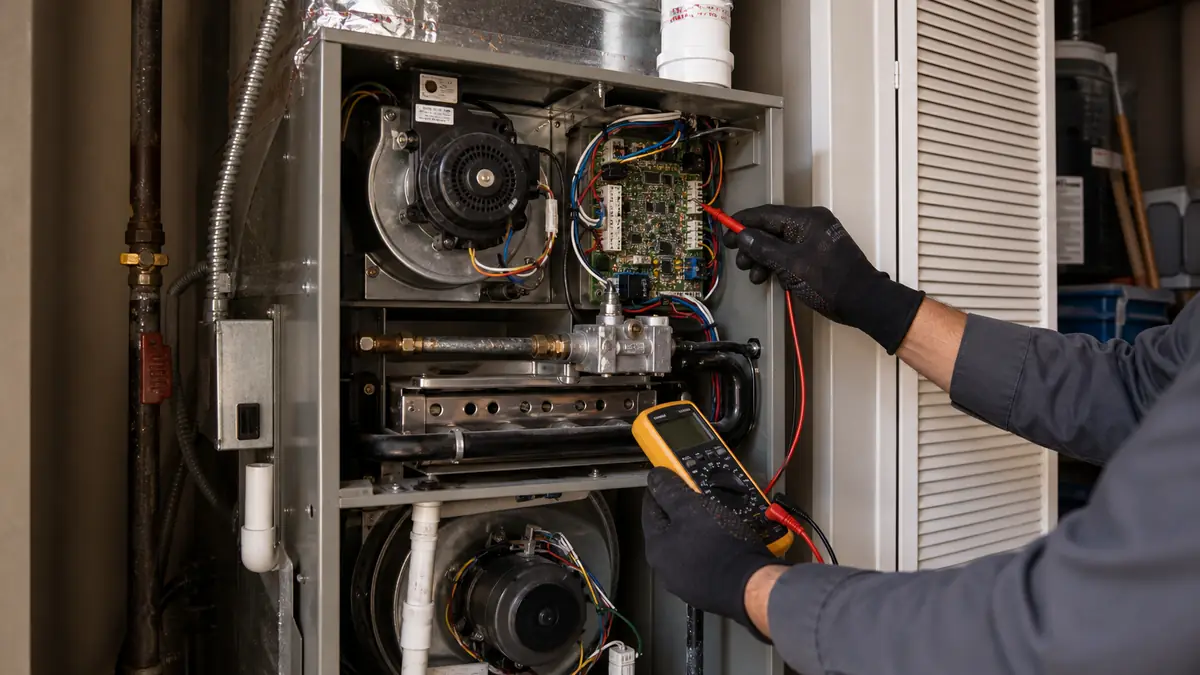
A no-heat call gets worked in one deliberate sequence so nobody on our Burbank crew is guessing parts onto your bill. First we confirm power: line voltage to the furnace and 24-volt control voltage off the transformer, since a blown control fuse mimics a dead board. Then we read the control board's status LED and count the flash code. Next we watch a full ignition attempt, the inducer spins up, the pressure switch should close, the hot-surface igniter glows, the gas valve opens, and the flame sensor should prove flame within a few seconds. Wherever that sequence stalls is the fault. We meter the suspect part, a flame sensor reads microamps of flame current, a pressure switch should close on inducer vacuum, an igniter shows continuity and resistance, before we condemn it. After the repair we cycle the furnace two or three times and check temperature rise across the heat exchanger against the rating-plate range, so a fixed furnace does not come back next week.
What do the furnace flash codes mean?
Most residential furnaces blink a status LED on the control board: a fast flash for a normal call for heat, and a counted pattern for a fault. These are the patterns we read first on a Burbank no-heat call, then verify with a meter before replacing anything. The numbers below follow the common Trane and Carrier integrated-furnace-control conventions you will see on many Burbank furnaces; we confirm against your unit's door legend.
| Flash pattern | Likely meaning / first check | Component / part | Cost lane |
|---|---|---|---|
| 2 flashes | System lockout, ignition retries exceeded | Igniter, gas supply, flame sensor | $120 - $500 |
| 3 flashes (Trane) / 31 (Carrier) | Pressure / vent switch did not close or reopened | Inducer motor, blocked flue, switch | $150 - $700 |
| 4 flashes (Trane) / 13, 33 (Carrier) | Open high-limit; low airflow | Dirty filter or coil, blower, limit switch | $120 - $450 |
| Rollout / 26 (Carrier) | Rollout switch open; safety | Inspect for cracked heat exchanger | Replace decision |
| 8 flashes (Trane) / 34 (Carrier) | Weak or lost flame signal | Clean or replace flame sensor | $120 - $300 |
| 9 flashes (Trane) / 14 (Carrier) | Igniter circuit / hard ignition lockout | Hot-surface igniter, gas valve circuit | $200 - $600 |
| Continuous on / 24 (Carrier) | Control fuse open or board failed | Control fuse, integrated control board | $120 - $800 |
Exact counts vary by furnace brand and board; we confirm against your unit's legend on the door.
What does a furnace repair cost in Burbank, and why?
The spread comes down to which part failed and whether it is on the truck. A dirty flame sensor or a weak hot-surface igniter is the cheap end, roughly $120 to $300, mostly the diagnostic plus a low-cost part. A pressure switch or a high-limit switch sits a step up at $150 to $450. The cost drivers that push a furnace repair higher are the inducer motor (around $300 to $700 installed) and the integrated control board, which can run $300 to $800 once you add the diagnostic and labor. A gas valve lands in between. Against those, a full furnace replacement runs about $3,000 to $7,500, with California Ultra-Low-NOx models standard here, which is why we lay the repair next to the replacement and the heat-pump path before you spend.
Should I repair the furnace or switch to a heat pump?
Burbank barely needs heat: the valley floor is cooling-dominant, and many homes run the furnace only a handful of mornings a year. If your furnace is old and the repair is significant, and you are already considering Mitsubishi ductless for the brutal summers, a single Hyper-Heating heat pump can cover both seasons and let you retire the gas furnace. We lay out the repair cost, the replacement cost and the dual-purpose heat-pump cost side by side. The general logic is in the repair-or-replace guide.
When is a furnace a safety issue, not a repair?
When a rollout switch trips or a high-limit keeps locking out, we test the heat exchanger. A cracked or overheating heat exchanger can leak combustion gases into the supply air, and no amount of cleaning makes that safe. We will red-tag a furnace in that condition and walk you through replacement, including the CA Ultra-Low-NOx models the state requires, rather than send you back to a hazard.
What is different about furnaces in Burbank homes?
Burbank's housing skews to 1920s-1940s Spanish and Tudor cottages and post-war ranch tract, and the heating equipment reflects that. Plenty of Magnolia Park and Chandler Park cottages were originally heated by a gravity wall furnace or a floor furnace, later supplemented with a closet or attic forced-air unit squeezed in decades after the house was built. Those retrofit furnaces often sit in a cramped attic that bakes past 130 F in summer, which ages the inducer motor and board faster than a conditioned closet would. Because Climate Zone 9 is cooling-dominant, most of these furnaces run only a few dozen mornings a year, so a part that fails has often been sitting idle and corroding rather than wearing out. That low annual runtime is also why, when a furnace needs a major repair, the math frequently favors a Hyper-Heat heat pump that earns its keep all summer instead of a gas furnace that runs a handful of weeks.
Common questions about Burbank furnace repair
My Burbank furnace lights then shuts off after a few seconds. Why?
That short-cycle on ignition is usually a dirty flame sensor: the burner lights, the control cannot prove flame, and it shuts the gas valve as a safety. Cleaning or replacing the flame sensor fixes most of these. If it keeps locking out, we check the igniter, gas valve and the control board's flash code.
Do I even need a furnace in Burbank?
Our winters are mild, so many homes barely run heat. If your gas furnace is failing and you are already adding Mitsubishi ductless for cooling, a Hyper-Heat heat pump can cover both, which may let you retire the furnace entirely. We will lay out both numbers honestly rather than just selling a furnace.
What does a furnace repair cost here?
Most Burbank furnace repairs land between a diagnostic of roughly 79 to 200 dollars and a few hundred for a flame sensor, igniter or pressure switch. A failed inducer motor or control board runs higher. A full furnace replacement is roughly 3,000 to 7,500 dollars, with California Ultra-Low-NOx models common.
Is a cracked heat exchanger really dangerous?
Yes. A rollout-switch trip or a recurrent limit lockout can point to a cracked or overheating heat exchanger, which can leak combustion gases. We test for it and will red-tag a furnace that is unsafe rather than patch around it. That is a replace-now situation, not a repair.
How long does a Burbank furnace repair take?
Most single-part repairs, a flame sensor, igniter, pressure switch or capacitor on the blower, are finished in one visit of about an hour or two once the part is on the truck. An inducer motor or control board can run longer if the part has to be sourced. We diagnose first, then tell you whether it is a same-visit fix or a return trip with a specific part.
My furnace worked last winter and now nothing. Where do you start?
We start at the control board flash code and confirm there is 24-volt control power and a clean flame-sense signal. A furnace that sat idle through a warm Burbank year often fails on a dirty flame sensor, a stuck pressure switch, or a rodent-chewed wire in the attic. Reading the code first keeps us from replacing a board when the real fault was a 12-dollar sensor.
See also: thermostat and control issues that mimic a no-heat call, heat pump installation as a furnace alternative, and the high energy bill page.