Air Duct Repair and Sealing in Burbank, CA
Straight answer: Burbank Mitsubishi HVAC tests, repairs and seals leaky ductwork across Burbank and the 91501 flats, so call (213) 513-5256 or book online for a leakage test. Original pre-1960 ducts in 130 F attics often leak 20 to 30 percent of the cooling you pay for; sealing runs a few hundred to $1,500, with HERS verification where Title-24 applies.
Key facts
- Duct sealing / minor repair commonly a few hundred to $1,500; full duct replacement about $1,900 - $6,000.
- Older Burbank ducts often leak 20-30 percent; sealing recovers cooling and cuts run time.
- Alter ducts in Climate Zone 9 and Title-24 generally calls for sealing backed by HERS field verification.
- We measure leakage before and after, so the improvement is documented, not promised.
- Ductless retrofit compared honestly against sealing when ducts are beyond saving.
- Service area: Burbank, Magnolia Park, Chandler Park, Media District (91501-91523).
Why is leaky ductwork so common in Burbank?
Most of Burbank's housing went up before 1960, and a lot of it was retrofitted with ducts decades after it was built, squeezed into a vented attic or a tight crawlspace. Those runs were often joined with cloth tape that has long since dried out and let go. On the valley floor, a summer attic can hit 130 F, so every joint that leaks is dumping expensive cool air into the hottest part of the house and pulling that 130 F attic air back in. The result is a system that runs longer, a back bedroom that never gets comfortable, and a cooling bill that does not match the equipment.
What does a duct service actually involve?
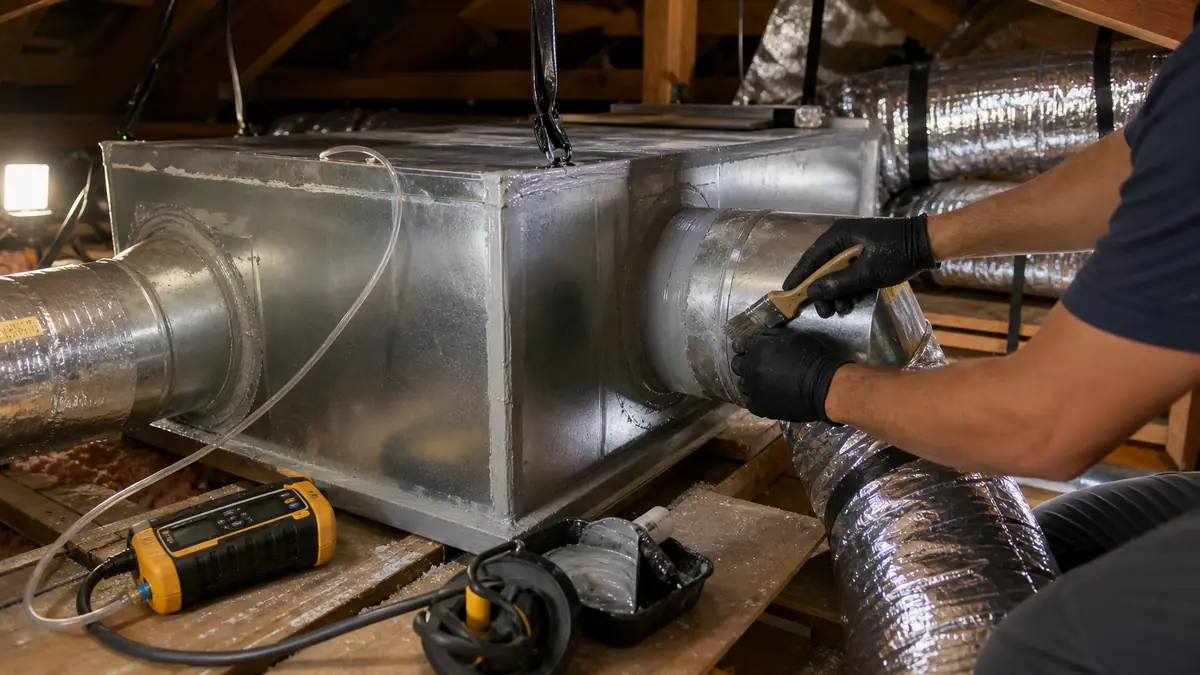
We start with a measurement, not a sales pitch. The sequence is: seal the registers, hook a calibrated duct-blaster fan to the system, pressurize the ductwork to a standard 25 pascals, and read total leakage in CFM. Then we crawl the attic or subarea, find the worst offenders, disconnected branch runs, dried-out cloth-tape joints, a leaking plenum or return chase, and decide run by run whether to seal or replace. Sealing uses brush-grade mastic and mechanical fasteners at the joints, boots, plenum and the return, not just foil tape that fails again in a 130 F attic. We re-run the duct-blaster test to prove the leakage number dropped. When Title-24 is in play, that closing re-test doubles as the HERS field verification the code expects, and you get the documented before-and-after.
| Symptom | Likely cause / first check | Cost lane |
|---|---|---|
| One room never cools | Disconnected or crushed branch run; undersized duct | $200 - $1,200 |
| Dusty house, fast filter loading | Return-side leakage pulling attic air; sealing needed | $300 - $1,500 |
| High bills, long run times | 20-30 percent supply leakage; seal and HERS verify | $400 - $2,000 |
| Whistling or roaring at registers | Undersized return, crushed flex, high static pressure | $300 - $1,800 |
| Uneven room-to-room temperatures | Poor duct balancing; missing dampers or kinked runs | $250 - $1,500 |
| Ducts brittle, asbestos-era tape | Full replacement of failed runs | $1,900 - $6,000 |
What does duct work cost in Burbank, and what drives the price?
The lane runs from a few hundred dollars for spot-sealing accessible joints to about $1,900 to $6,000 for replacing failed runs across a whole home, and the drivers are access, length and condition. A single-story Magnolia Park cottage with a walkable attic is quick and cheap to seal; a low-clearance crawlspace or a finished-ceiling chase doubles the labor. Total replacement makes sense when the flex is brittle, the runs are undersized for the new equipment, or old tape has failed everywhere at once. Two add-ons commonly ride along: upsizing an undersized return so a high-static Mitsubishi air handler can breathe, and adding or repairing the HERS-verified sealing the code triggers once you alter the system. We price the leakage test, the sealing and any replacement as separate lines so you see exactly where the money goes.
Why is this a Burbank-specific problem?
Burbank's stock is overwhelmingly pre-1960, 1920s-1940s Spanish and Tudor cottages and post-war ranch, and most of it never had ducts in the original design. Forced-air systems were retrofitted in later, run through whatever attic or crawlspace was available, and joined with cloth tape that has since dried and let go. On the southeastern San Fernando Valley floor, those attics routinely hit 130 F in July, so every leaking supply joint dumps cool air into the hottest space in the house while the return pulls that superheated attic air back into your living room. That is why a Burbank duct test so often comes back at 20 to 30 percent leakage, and why sealing usually pays for itself faster here than in a milder coastal zone.
Seal the ducts or go ductless?
It depends on the house. A 1950s Burbank Hills ranch with mostly sound ducts is worth sealing, then pairing with a Mitsubishi SVZ or MVZ ducted air handler so you keep the registers and gain inverter efficiency. A small Magnolia Park cottage whose ducts are a lost cause is usually better off with a ductless mini-split that erases the duct problem. We run both numbers, because spending 4,000 dollars sealing ducts you should have abandoned helps no one.
Should I seal before or alongside a new Mitsubishi system?
If you are keeping ducts, seal before or with the install, never after. A high-SEER2 Mitsubishi inverter is rated at the equipment, and the rating only reaches your rooms if the ducts hold their air, so commissioning a new SVZ or MVZ air handler onto 20-to-30-percent-leaky runs throws away part of what you paid for. Sealing alongside the install also lets us match the duct system to the new air handler's static-pressure needs and upsize an undersized return in the same trip, which is far cheaper than a second visit. On a Title-24 job the sealing and its HERS verification are usually triggered by the system change anyway, so doing it together keeps the permit clean.
How does this connect to my energy bill?
Duct leakage is one of the biggest hidden drivers of a high Burbank cooling bill, right alongside an oversized or dirty system. If your bills jumped this summer, the high energy bill troubleshooting page walks through the full checklist, and a duct test is usually step two after the filter.
Common questions about Burbank duct repair
How do I know my Burbank ducts are leaking?
Tell-tale signs are one room that never cools, a dusty house no matter how often you change the filter, and a cooling bill that climbs while the AC runs longer. In Burbank's pre-1960 homes the ducts are often original, hand-taped at the joints, and snaking through a vented attic that hits 130 F in summer, so 20 to 30 percent leakage is common.
Is duct sealing worth it before a new system?
Almost always. Putting a high-SEER2 Mitsubishi inverter on leaky ducts is like new tires on a car with a hole in the gas tank. We test, seal and verify the ducts first so the equipment you pay for conditions the rooms instead of the attic. In many cases Title-24 has you HERS-verify that work regardless.
What does duct work cost in Burbank?
Sealing and minor repair is a few hundred to roughly 1,500 dollars depending on access; a full duct replacement runs about 1,900 to 6,000 dollars, more for a large home with complex runs through an old crawlspace. We measure leakage before and after so you see the result.
Can I just go ductless and skip the ducts?
Often yes. For a small Magnolia Park cottage with hopeless 1930s ducting, a Mitsubishi mini-split or multi-zone system removes the duct problem entirely. We will compare sealing your ducts against a ductless retrofit so you spend on whichever wins.
How do you actually measure duct leakage?
We use a duct blaster, a calibrated fan that pressurizes the duct system to a standard 25 pascals, and read how much air escapes in CFM. That number, compared against the system's airflow, tells us the leakage percentage. We run it before sealing and again after, so the improvement is a measured figure, and on a Title-24 job that closing test is the HERS field verification.
Will sealing ducts help in winter too, or just summer cooling?
Both, though Burbank's payoff is mostly summer. Sealed supply ducts deliver more of the cooling you paid for during a Climate Zone 9 heat stretch, and on the few mornings the furnace runs, the same sealing keeps heated air out of a cold attic. Because the valley floor is cooling-dominant, the bigger dollar savings show up on the summer electric bill.
Related: maintenance calendar for filter and coil timing, and ductless installation.